
Study in Quebec City in 2026
Table of Contents
- Why Studying in Quebec City is a Right Choice for Indian Students
- Education System in Quebec City
- Popular Courses to Study in Quebec City for Indian Students in 2026
- Eligibility by Degree Level
- Most Preferred Areas for Indian Students in Quebec City
- Job Opportunities in Quebec City for Indian Students in 2026
- Immigration and Permanent Residency
- Scholarships for Indian Students in Quebec City
- Top 5 Scholarships
- Tips for Indian Students Planning to Study in Quebec City
- Author's Final Thoughts
Study in Quebec City in 2026 offers Indian students a unique blend of European charm, North American academic excellence, and highly affordable tuition compared to Montreal or Toronto. This historic, French-speaking hub provides world-class education at renowned institutions like Université Laval and local CEGEPs.
To kickstart this journey, Indian applicants will navigate a streamlined administrative process, securing both a Quebec Acceptance Certificate (CAQ) and a Canadian Study Permit. Embrace a rich cultural immersion while achieving your academic goals in one of Canada’s most vibrant, budget-friendly student cities.
Here is a key highlights table for Indian students considering Quebec City in 2026.
Feature | Key Highlight |
Primary Advantage | Significantly more affordable tuition and cost of living compared to Toronto or Montreal. |
Academic Hubs | Home to world-class institutions like Université Laval and specialized CEGEPs. |
Administrative Steps | Requires both a Quebec Acceptance Certificate (CAQ) and a Canadian Study Permit. |
Language Dynamics | French is the primary language; learning it is highly recommended for daily life and job success. |
Work Opportunities | High demand in AI, IT, green energy, and engineering with competitive salary ranges. |
PR Pathway | The Quebec Experience Program (PEQ) offers an accelerated route to permanent residency. |
Financial Support | Multiple scholarships available, including the Quebec Merit Scholarship (PBEEE). |
Winter Preparation | Essential to budget for specialized, high-quality winter clothing for severe weather. |
Why Studying in Quebec City is a Right Choice for Indian Students
Quebec City offers an unparalleled ecosystem for Indian students looking for high-quality education and long-term career prospects. The city seamlessly combines modern innovation with a safe, welcoming, and culturally rich environment.
Affordable Cost of Living: Compared to Toronto and Vancouver, Quebec City offers significantly lower rent and utility costs, making it highly budget-friendly for international students.
World-Class Institutions: Home to Université Laval, the oldest French-language university in North America, offering cutting-edge research facilities.
Favorable PR Pathways: The Quebec Experience Program (PEQ) provides a streamlined and accelerated route for international graduates to obtain permanent residency.
Booming Job Market: A rapidly growing tech and green energy sector provides numerous internship and post-graduation job opportunities for qualified graduates.
Safe and Inclusive: Consistently ranked as one of the safest cities in North America, ensuring a secure and supportive environment for Indian students.
Rich Cultural Experience: Offers a unique blend of North American efficiency and European charm, with vibrant festivals, architecture, and a welcoming Francophone culture.
Education System in Quebec City
The education system in Quebec is unique within Canada, designed to provide specialized, practical, and rigorous academic training. It ensures students are well-prepared for both university-level research and direct entry into the workforce.
CEGEP Network: Unique to Quebec, CEGEPs offer two-year pre-university programs or three-year technical programs that act as a required bridge between high school and university.
Bachelor’s Degrees: Typically take only three years to complete in Quebec (if preceded by CEGEP), saving students considerable time and tuition fees.
Master’s Degrees: Generally, require two years of study, focusing heavily on applied research, specialized professional skills, and industry internships.
Doctoral Programs (PhD): Highly research-intensive programs taking 3-5 years, often supported by generous provincial and federal research grants.
Language of Instruction: While predominantly French, many institutions offer select English-taught graduate programs, bilingual courses, and intensive French immersion pathways.
Practical Integration: There is a strong emphasis on co-op programs and internships, allowing students to gain paid, hands-on industry experience before graduating.
Popular Courses to Study in Quebec City for Indian Students in 2026
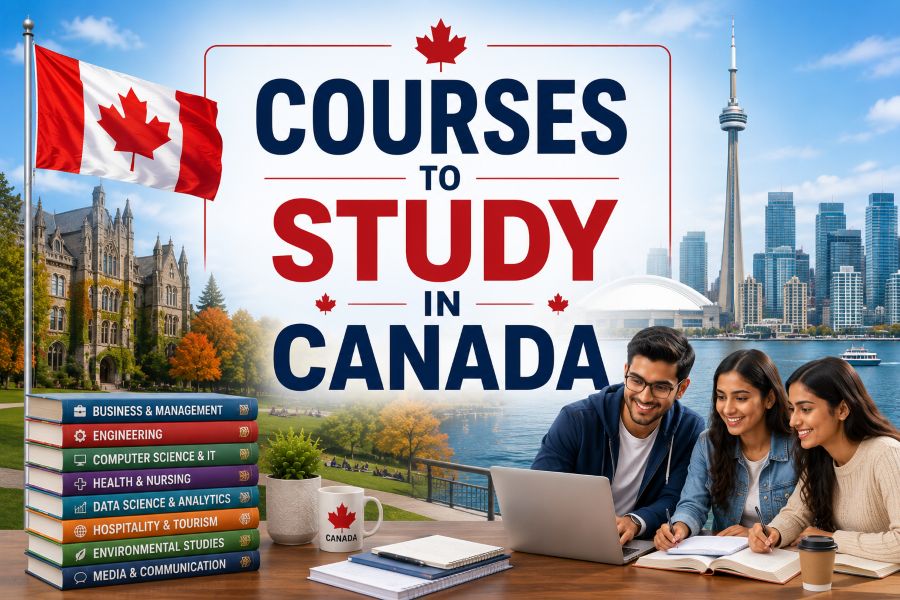
Choosing the right course and institution is pivotal for securing a successful global career after graduation. Below is a comprehensive look at the most sought-after academic categories, featuring top-ranked universities across Quebec and Canada.
Engineering & IT
These programs are designed to produce highly skilled tech professionals ready for the competitive Canadian market.
Popular Courses | Top Universities | QS Global Rank (2027) |
B.Eng in Computer Science | McGill University | #30 |
M.Eng in Mechanical Engineering | University of Toronto | #32 |
MSc in Artificial Intelligence | Université de Montréal | #162 |
B.Eng in Software Engineering | Université Laval | =469 |
M.Eng in Information Technology | University of Alberta | #96 |
Source: QS World University Rankings 2027
Business & Finance
Business degrees in Quebec City open doors to lucrative corporate roles in multinational companies and expanding local enterprises.
Popular Courses | Top Universities | QS Global Rank (2027) |
Master of Business Administration (MBA) | McGill University | #30 |
BBA in Finance | Western University | =142 |
MSc in Financial Analytics | McMaster University | =174 |
Master in Management | Université de Montréal | #162 |
BBA in International Business | Université Laval | =469 |
Source: QS World University Rankings 2027
Digital Marketing & Arts
These dynamic courses focus on creativity, mass communication, and data-driven marketing, which are essential for modern digital landscapes.
Popular Courses | Top Universities | QS Global Rank (2027) |
Bachelor of Digital Marketing | University of British Columbia | #45 |
MA in Media Studies | Queen's University | =179 |
BA in Graphic Design | University of Ottawa | =228 |
MSc in Marketing Strategy | Simon Fraser University | #312 |
BA in Fine Arts | York University | =322 |
Source: QS World University Rankings 2027
Environmental Sciences
These forward-thinking courses are ideal for students passionate about climate action, sustainability research, and public policy administration.
Popular Courses | Top Universities | QS Global Rank (2027) |
MSc in Environmental Sciences | McGill University | #30 |
BSc in Climate Action & Policy | University of Calgary | #249 |
Master of Public Administration | Université de Montréal | #162 |
MSc in Renewable Energy | Université Laval | =469 |
BSc in Sustainability Studies | University of Alberta | #96 |
Source: QS World University Rankings 2027
Healthcare & Sciences
Aimed at producing top-tier researchers and healthcare administrators to support Canada's robust medical and scientific sectors.
Popular Courses | Top Universities | QS Global Rank (2027) |
BSc in Nursing | University of Toronto | #32 |
MSc in Clinical Research | McGill University | #30 |
Master of Public Health | McMaster University | =174 |
BSc in Biotechnology | Université de Montréal | #162 |
MD / Medical Sciences | Université Laval | =469 |
Source: QS World University Rankings 2027
Eligibility by Degree Level
Meeting the precise academic benchmarks is the crucial first step for Indian students wishing to secure admission to institutions in Quebec City. Depending on whether you are applying for an undergraduate, master's, or doctoral program, the eligibility criteria vary significantly to ensure candidates possess the necessary foundational knowledge.
Here is the table outlining the general eligibility requirements based on the degree level.
Degree Level | Eligibility Criteria |
Bachelor’s Degree | High school diploma with minimum 70% aggregate; specific subject requirements (e.g., Math/Science for Engineering). |
Master’s Degree | A 3 or 4-year Bachelor’s degree in a relevant field with a minimum GPA of 3.0/4.0 or 70-75%. |
PhD / Doctorate | A Master’s degree with a strong research background, published papers, and a solid research proposal. |
Required Documents
Compiling a complete, accurate, and properly formatted document checklist will prevent unnecessary processing delays.
Here is the table detailing the mandatory documents required for both university admissions and visa applications.
Document Type | Description |
Academic Transcripts | Official mark sheets and degree certificates from all previous educational institutions. |
CAQ & Study Permit | Quebec Acceptance Certificate and federal Canadian Study Permit approval letters. |
Letters of Recommendation (LOR) | 2-3 academic or professional references endorsing the candidate's capabilities. |
Valid Passport: Must be valid for at least six months beyond your intended period of stay in Canada to satisfy immigration requirements.
Statement of Purpose (SOP): A well-crafted, personalized essay explaining your motivation to study in Quebec and your long-term career plans.
Proof of Financial Support: Certified bank statements demonstrating the ability to cover first-year tuition plus a minimum of 15,000 CAD (1,001,550 INR) for living expenses.
Resume/CV: An updated, professionally formatted resume highlighting your academic achievements, internships, leadership roles, and extracurriculars.
Passport-Size Photographs: Recent, high-quality photos conforming strictly to Canadian visa specifications (white background, specific dimensions).
Standardized Tests
Standardized test scores help universities objectively assess a candidate's academic readiness for rigorous North American coursework.
Here is the table showing the most common standard exams and their typical score requirements for Indian students.
Exam | Accepted For | Minimum Score Range |
GRE | Master's/PhD (Engineering/Sciences) | 300 - 320+ |
GMAT | MBA / Business Programs | 600 - 650+ |
SAT | Undergraduate Programs (Optional) | 1200 - 1350+ |
GRE/GMAT Waivers: Many Quebec universities have recently waived these requirements for applicants entering with exceptionally high GPAs or extensive work experience.
Test Validity Period: Ensure your standardized test scores are valid (typically 5 years for GRE/GMAT) at the exact time of submitting your application.
Sectional Cut-offs: Top business and engineering schools may look for exceptionally high quantitative scores rather than just a high overall average.
Dedicated Preparation: Indian students should dedicate at least 3-4 months to prepare for these competitive exams to meet top-tier university benchmarks.
Official Submission: Always send your official test scores directly through the testing agency's online portal to the university; self-reported scores are rarely accepted.
Language Proficiency
Proving your ability to communicate effectively in either English or French is a mandatory admission criterion.
Here is the table outlining the widely accepted language tests and the general minimum scores required.
Language Test | Minimum Score Required |
IELTS (English) | 6.5 Overall (No band less than 6.0) |
TOEFL iBT (English) | 85 - 90 Overall |
TEF / TCF (French) | B2 Level Minimum |
Medium of Instruction Details: Always double-check your program's specific language requirements, as some are exclusively French, exclusively English, or fully bilingual.
The French Advantage: Submitting a strong TEF or TCF score significantly boosts your chances for permanent residency under Quebec's provincial programs.
IELTS Academic Requirement: Ensure you register for and take the "Academic" version of the IELTS exam, not the "General Training" version used for standard immigration.
Duolingo English Test (DET): Accepted by a growing number of institutions for undergraduate admissions (typically requiring a score of 115 or higher).
Language Test Exemptions: Students who have completed previous multi-year degrees entirely in English may sometimes request a formal language test waiver.
Tuition Fees (Course Wise)
Understanding the precise financial commitment is crucial for effective budgeting and long-term planning.
Here is a table outlining the estimated annual tuition fees for 5 popular academic courses:
Course Program | Annual Tuition (CAD) | Annual Tuition (INR) |
B.Eng in Computer Science | 22,000 - 30,000 CAD | 1,468,940 - 2,003,100 INR |
Master of Business Administration (MBA) | 25,000 - 45,000 CAD | 1,669,250 - 3,004,650 INR |
MSc in Environmental Sciences | 18,000 - 24,000 CAD | 1,201,860 - 1,602,480 INR |
Bachelor of Digital Marketing | 20,000 - 28,000 CAD | 1,335,400 - 1,869,560 INR |
M.Eng in Mechanical Engineering | 19,000 - 26,000 CAD | 1,268,630 - 1,736,020 INR |
Most Preferred Areas for Indian Students in Quebec City
Choosing the right neighborhood in Quebec City can greatly enhance your student experience, offering daily convenience, safety, and a sense of community.
Sainte-Foy: The undisputed student hub located directly adjacent to Université Laval; it offers highly accessible public transit, numerous student housing options, and bustling commercial centers.
Montcalm: Known as the premier arts district, it is perfect for students seeking a vibrant, culturally rich environment filled with cafes, independent galleries, and green parks.
Saint-Roch: A rapidly modernizing downtown area popular among IT and tech students, characterized by trendy lofts, innovative co-working spaces, and vibrant nightlife.
Limoilou: Highly affordable and community-focused, this neighborhood is famous for its charming residential streets, local farmer markets, and family-friendly atmosphere.
Vieux-Québec (Old Quebec): While more expensive, it provides an immersive, breathtaking historical experience for students who want to live amidst UNESCO World Heritage architecture.
Cap-Rouge: A quieter, highly scenic suburban borough ideal for postgraduate or doctoral students looking for a peaceful, nature-filled environment to focus on their research.
Job Opportunities in Quebec City for Indian Students in 2026
Graduating from Quebec City opens a promising job market characterized by stability, continuous growth, and an increasing need for international talent. With thriving technology, engineering, and commerce sectors, Indian students can seamlessly transition into lucrative post-graduation employment.
In-Demand Domains as per the Current Market Scenario
The local economy is rapidly expanding, creating a massive demand for skilled professionals in several key modern sectors.
Artificial Intelligence & IT: Quebec is a booming global tech hub requiring advanced software developers, data scientists, and AI specialists.
Green Economy & Renewables: There is a high demand for environmental engineers and sustainability consultants to support provincial climate initiatives.
Advanced Manufacturing & Mechanics: Opportunities abound for mechanical and industrial engineers in modernized manufacturing and aerospace plants.
Healthcare & Life Sciences: An ever-growing need for dedicated clinical researchers, lab technicians, and public health administrators.
Finance & Fintech: Strong demand for highly analytical financial analysts, quantitative modellers, and strategic business managers in the corporate sector.
Top Job Roles and Salary
Securing a clear understanding of the local pay scale helps Indian graduates effectively evaluate their long-term financial growth and career sustainability in Quebec City's top-tier sectors.
Here is the table outlining top post-graduation job roles and their corresponding competitive salaries.
Job Role | Salary Range (CAD) | Salary Range (INR) |
Software Engineer | 65,000 - 95,000 CAD | 4,340,050 - 6,343,150 INR |
Data Analyst | 55,000 - 80,000 CAD | 3,672,350 - 5,341,600 INR |
Financial Analyst | 50,000 - 75,000 CAD | 3,338,500 - 5,007,750 INR |
Mechanical Engineer | 60,000 - 90,000 CAD | 4,006,200 - 6,009,300 INR |
Digital Marketing Manager | 55,000 - 85,000 CAD | 3,672,350 - 5,675,450 INR |
Supply Chain Manager | 60,000 - 90,000 CAD | 4,006,200 - 6,009,300 INR |
Research Assistant | 45,000 - 65,000 CAD | 3,004,650 - 4,340,050 INR |
Source: Glassdoor
Immigration and Permanent Residency
Quebec offers unique, streamlined immigration pathways specifically designed to retain international graduates within the province. Understanding these routes early on will help you strategically plan your long-term settlement in Canada.
Pathway from Student to PR
Navigating the immigration system requires a clear understanding of provincial requirements and post-graduation work permits.
Post-Graduation Work Permit (PGWP): Graduates from eligible Quebec institutions can secure a PGWP, allowing them to legally work anywhere in Canada for up to three years.
Quebec Experience Program (PEQ): This highly accelerated pathway allows international graduates with advanced intermediate French skills to apply for provincial selection quickly.
Regular Skilled Worker Program (QSWP): An alternative, point-based system for graduates who may not meet the stringent PEQ French requirements but possess highly in-demand skills.
Language Proficiency Importance: Achieving a Level 7 (B2) in spoken French is undeniably the most critical requirement for unlocking seamless permanent residency in Quebec.
Federal Express Entry Integration: After obtaining a CSQ (Quebec Selection Certificate), applicants can easily apply to the federal government for their official PR status.
Scholarships for Indian Students in Quebec City
Financial aid can significantly reduce the burden of studying abroad, making higher education much more accessible. Several governmental and institutional scholarships are available specifically to support outstanding international students.
Top 5 Scholarships
To help you offset the cost of international education, several provincial, institutional, and federal funding options are available. The table below outlines the top 5 scholarships, their target levels, and their respective financial values.
Scholarship Name | Financial Value (CAD) | Financial Value (INR) |
Quebec Merit Scholarship (PBEEE) | Up to 35,000 CAD per year + health insurance | Up to 2,336,950 INR per year + health insurance |
Université Laval Excellence Scholarships | 2,000 CAD - 10,000 CAD (Variable) | 133,540 INR - 667,700 INR (Variable) |
Shastri Indo-Canadian Institute Fellowships | 1,000 CAD - 10,000 CAD (Depending on project) | 66,770 INR - 667,700 INR (Depending on project) |
Banting Postdoctoral Fellowships | 70,000 CAD per year (For 2 years) | 4,673,900 INR per year (For 2 years) |
Vanier Canada Graduate Scholarships | 50,000 CAD per year (For 3 years) | 3,338,500 INR per year (For 3 years) |
Tips for Indian Students Planning to Study in Quebec City
Relocating to a new country requires meticulous planning, financial foresight, and strategic cultural adjustments. To ensure a seamless transition to Quebec City, keep these essential steps in mind before and after your arrival.
Learn Basic French: Quebec City is predominantly Francophone; knowing conversational French will significantly boost your part-time and full-time job prospects.
Secure Your CAQ Early: You must obtain a Quebec Acceptance Certificate (CAQ) before applying for a Study Permit, so start the paperwork months in advance.
Prepare for Harsh Winters: Allocate a specific budget (around 300-500 CAD / 20,031-33,385 INR) to purchase high-quality thermal wear and snow boots upon your arrival.
Network Aggressively: Utilize international student services, career fairs, and local industry summits to connect with potential employers early on.
Budget Finances Effectively: Maintain a strict monthly budget of around 1,200 - 1,500 CAD (80,124 - 100,155 INR) to comfortably cover your rent and groceries.
Author's Final Thoughts
In 2026, Quebec City stands out as an exceptional destination for Indian students seeking a high-quality, budget-friendly international education. With esteemed institutions holding strong global QS rankings, students are guaranteed academic excellence. The city’s booming job market offers lucrative salaries across IT, engineering, finance, and marketing sectors, ensuring a seamless transition from student to professional.
Furthermore, clear pathways like the Quebec Experience Program (PEQ) make achieving permanent residency a tangible goal. By preparing for the linguistic and climatic shifts, and securing valuable scholarships, Indian students can thrive in this culturally rich environment. Ultimately, studying in Quebec City is a strategic investment toward a prosperous and stable global career.
Ready to embark on your academic journey in Quebec City? Connect with our experts to know about concerned universities, courses, scholarships, admissions, and career opportunities.