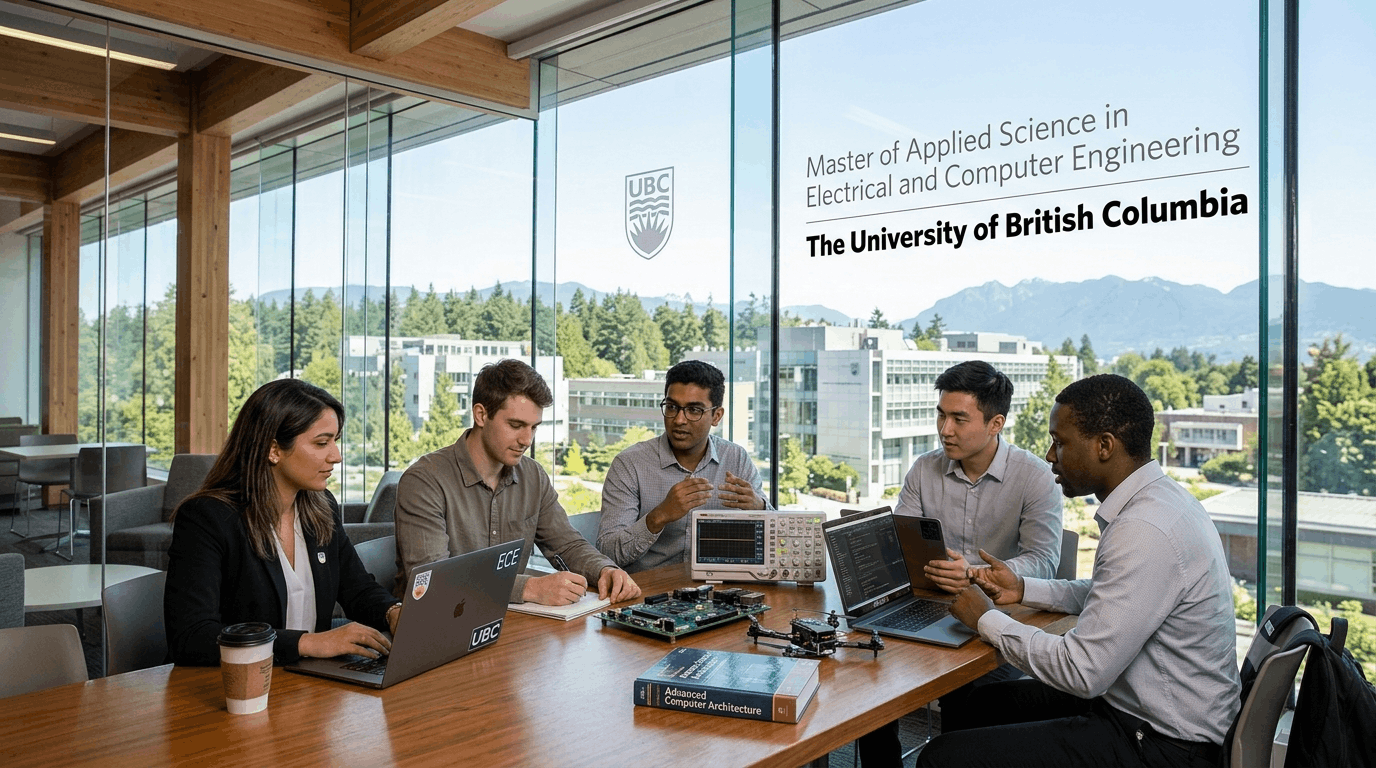
Master of Applied Science in Electrical and Computer Engineering at the University of British Columbia
Table of Contents
- Why Study MASc Electrical and Computer Engineering at UBC
- Course Structure of MASc Electrical and Computer Engineering at UBC
- Eligibility and Admission Requirements for MASc Electrical and Computer Engineering at UBC
- How to Apply for MASc Electrical and Computer Engineering at UBC
- Cost of MASc Electrical and Computer Engineering at UBC
- Living Expenses for MASc Students in Vancouver
- Student Visa Requirements for MASc Electrical and Computer Engineering at UBC
- Career Opportunities After MASc Electrical and Computer Engineering at UBC
- Author's POV
The Master of Applied Science in Electrical and Computer Engineering at The University of British Columbia is a two-year, research-intensive postgraduate programme designed for students who want to deepen their expertise in electrical and computer engineering. Combining advanced coursework with an original research thesis, the programme helps students develop strong analytical, technical, and problem-solving skills.
Under the guidance of experienced faculty, students contribute to innovative research in areas such as communications, artificial intelligence, robotics, semiconductor devices, and power systems. The Master of Applied Science in Electrical and Computer Engineering at The University of British Columbia also provides an excellent foundation for careers in industry, research organisations, or further doctoral studies.
Key Highlights: MASc Electrical and Computer Engineering at UBC
Key Highlights | Course Details |
Programme Duration | Average 3.2 years to completion, coursework plus thesis |
Degree Awarded | Master of Applied Science (MASc), Electrical and Computer Engineering |
University Ranking | #45 globally, QS World University Rankings 2027 |
Tuition (First Year, International) | CAD 10,081.65 (approx. INR 6.40 lakh) |
Tuition (First Year, Domestic) | CAD 5,738.52 (approx. INR 3.64 lakh) |
Median Net Funding | CAD 22,970/year (after tuition and fees deducted), for 50% of funded students |
Graduation Rate | 97.6% |
Post-Study Work Option | Post-Graduation Work Permit (PGWP), up to 3 years |
Why Study MASc Electrical and Computer Engineering at UBC
UBC's #45 position in the QS World University Rankings 2027 reflects a genuinely strong overall institution, but what makes this specific MASc programme stand out is the department itself, one of UBC's largest graduate programmes, with faculty collaborating across the Faculty of Medicine, Faculty of Science, and industry partners on real research problems.
The programme pulls students from a genuinely global pool, with recent cohorts including admits from Argentina, Bangladesh, China, Ethiopia, Germany, India, Iran, Japan, Mexico, Sri Lanka, Ukraine, and the United States, among many others, alongside domestic Canadian students.
A few reasons candidates still choose UBC for this specific research master's:
Access to five distinct research areas, Biomedical Technologies, Communications Systems, Computer and Software Systems, Energy Systems, and Micro and Nano Technologies
Over 75 faculty members actively supervising research, working alongside colleagues in Medicine and Science and with industry leaders
A genuinely strong funding structure, with 66 of 75 funded students in a recent cohort receiving Research Assistantships worth a median of CAD 25,000 (approx. INR 15.9 lakh).
Unlimited on-campus work hours for international students, plus up to 24 hours per week off-campus during academic sessions
Access to UBC's cutting-edge research facilities and centres of excellence, alongside real fieldwork opportunities
A programme genuinely open to students from closely related fields, not strictly limited to electrical or computer engineering undergraduates
Course Structure of MASc Electrical and Computer Engineering at UBC
The MASc combines required coursework with a substantial thesis component, and students choose a specific research area early on, working closely with a faculty supervisor on problems ranging from industry-adjacent applications to emerging fields like quantum computing and nanotechnology.
Recent thesis titles from the department genuinely show the range on offer, from FPGA memory architectures for machine learning to cryogenic photodetectors, EV charging systems, and echocardiography video analysis, reflecting just how broad the five specialisation areas actually are in practice.
Course Structure:
Programme Component | What It Covers |
Coursework | Graduate-level courses aligned with your chosen research specialisation |
Thesis Research | Original research conducted under faculty supervision, published through UBC's open library |
Specialisation Areas | Biomedical Technologies, Communications Systems, Computer and Software Systems, Energy Systems, Micro and Nano Technologies |
Average Completion Time | 3.2 years, ranging from 1.7 to 7.3 years depending on the student |
How Faculty Supervision Actually Works:
Unlike a coursework-only master's, admission to the MASc genuinely depends on finding faculty fit, applicants are encouraged to browse faculty profiles and indicate their preferred supervisor directly in their application, though no formal commitment is required beforehand.
Faculty members then review applications based specifically on research interest alignment and whether they have available student positions, meaning your specific research proposal and supervisor match matters as much as your raw academic scores.
Eligibility and Admission Requirements for MASc Electrical and Computer Engineering at UBC
Admission to UBC's MASc programme requires a completed four-year bachelor's degree in electrical or computer engineering or a closely related field, alongside a strong academic record and, for most international applicants, English proficiency test scores.
Academic Requirements:
A UBC-accredited four-year Bachelor's degree in Electrical or Computer Engineering, or a closely related field with significant course overlap
A GPA in the first-class range is preferred, alongside demonstrated aptitude for research
GRE scores are not mandatory, though applicants may submit them voluntarily to strengthen their application
English Language Requirements:
International applicants whose prior degree wasn't taught in English at an institution based in specific waived countries must submit an approved test score, taken within the last 24 months.
Test | Overall Score Requirement | Section Breakdown |
TOEFL iBT | 100 | Reading 22, Writing 21, Speaking 21, Listening 22 |
IELTS Academic | 7.0 | Reading 6.0, Writing 6.0, Speaking 6.0, Listening 6.0 |
Note: Applicants who completed their most recent degree within the past five years in countries including Australia, Canada, Ireland, New Zealand, Singapore, South Africa, the United Kingdom, the United States, and several others don't need to submit a language score at all.
How to Apply for MASc Electrical and Computer Engineering at UBC
Applying to UBC's MASc programme requires genuinely early planning, since finding a compatible faculty supervisor is a meaningful part of a successful application, not just an administrative afterthought.
Step | What to Do |
Step 1: Check Your Eligibility | Confirm you meet the academic and English language requirements for the programme |
Step 2: Identify Potential Supervisors | Browse faculty profiles and identify researchers whose work matches your interests |
Step 3: Reach Out to Faculty | Contact potential supervisors directly, though no formal commitment is required before applying |
Step 4: Prepare Your Application Materials | Gather transcripts, a statement of interest, and three letters of reference |
Step 5: Submit Your Online Application | Apply through UBC's official graduate application portal before the stated deadline |
Step 6: Upload Transcripts | Submit scanned official transcripts through the applicant portal by the transcript deadline |
Step 7: Confirm Referee Submissions | Ensure your three references submit their letters before the referee deadline |
Step 8: Apply for Your Canadian Study Permit | Once accepted, apply for your study permit through IRCC using your official offer letter |
For the September 2027 intake, applications open on 15 October 2026, with both the Canadian and international applicant deadline set at 15 January 2027, alongside matching transcript and referee deadlines by 31 January 2027.
Cost of MASc Electrical and Computer Engineering at UBC
The total cost of this MASc genuinely differs from most other master's programmes covered so far, since UBC's own data shows most students recover a meaningful portion of their tuition through research and teaching assistantship funding tied to the degree itself.
First-Year Tuition Fees for International Students
The tuition fee for the Master of Applied Science in Electrical and Computer Engineering at The University of British Columbia is comparatively affordable for a research-based programme. International students should also budget for living expenses, health insurance, and other academic costs when estimating their total study expenses.
Residency Status | First-Year Tuition (CAD) | First-Year Tuition (INR, approx.) |
International Students | CAD 10,081.65 | INR 6.40 lakh |
Domestic Students | CAD 5,738.52 | INR 3.64 lakh |
Note: UBC's Board of Governors reviews tuition annually, with recent increases running 2 percent for continuing domestic students and 2 to 5 percent for continuing international students. New incoming students may see a different rate than continuing students.
Research Funding and Assistantships at UBC:
Based on UBC's own published Graduate Funding & Support Study, covering 75 students in this programme, the numbers tell a genuinely different cost story than the headline tuition figure alone.
Funding Metric | Amount (CAD) | Amount (INR, approx.) |
Mean gross funding per year (before tuition/fees) | CAD 32,093 | INR 20.4 lakh |
Median net funding per year (after tuition/fees deducted) | CAD 22,970 | INR 14.6 lakh |
Median Research Assistantship funding (66 students) | CAD 25,000 | INR 15.9 lakh |
Median Teaching Assistantship funding (45 students) | CAD 6,216 | INR 3.95 lakh |
Hence, for roughly half of funded students in this programme, tuition costs are more than offset by research or teaching assistantship income, meaning many MASc students end their first year with a genuine net financial gain rather than an out-of-pocket cost.
Living Expenses for MASc Students in Vancouver
Along with tuition fees, international students should budget for accommodation, food, transportation, utilities, and personal expenses while studying in Vancouver. Although Vancouver is one of Canada's most expensive cities, careful budgeting and shared accommodation can help students manage their monthly expenses more effectively.
According to Numbeo, a single person's average monthly living cost, excluding rent, is approximately CAD 1,121 (approx. INR 71,200).
Expense Category | Average Monthly Cost (CAD) | Approx. Cost (INR) |
Living expenses (excluding rent) | 1,121 | 71,200 |
One-bedroom apartment (City Centre) | 1,942 | 1.23 lakh |
One-bedroom apartment (Outside City Centre) | 1,629 | 1.03 lakh |
Monthly public transport pass | 82 | 5,200 |
One-way local transport ticket | 3 | 190 |
Note: Living costs are approximate and may vary depending on accommodation type, lifestyle, and exchange rates.
Student Visa Requirements for MASc Electrical and Computer Engineering at UBC
International students admitted to UBC's MASc programme must apply for a Canada Study Permit through IRCC before travelling, the same process required for any full-time graduate programme at a Canadian Designated Learning Institution.
Financial Requirements
Students must show proof of funds covering tuition plus living costs, though UBC's own data suggests many MASc students substantially offset this through assistantship funding tied directly to their research.
Cost Item | Amount (CAD) | Amount (INR, approx.) |
Proof of Financial Capacity (living costs, annual, IRCC standard) | CAD 20,635 | INR 13.1 lakh |
Study Permit Application Fee | CAD 150 | INR 9,530 |
Biometrics Fee | CAD 85 | INR 5,400 |
Work Rights While Studying:
International students enrolled full-time with a valid study permit can work on campus for unlimited hours, and off-campus for no more than 24 hours per week during academic sessions, a genuinely generous allowance compared to most other study destinations.
Career Opportunities After MASc Electrical and Computer Engineering at UBC
MASc graduates from UBC's Electrical and Computer Engineering department move into hardware design, firmware development, systems engineering, and power systems roles across Vancouver's growing tech and engineering sector.
Top Job Roles and Salary Ranges in Vancouver, BC:
Role | Vancouver Salary Range (CAD) | Vancouver Salary Range (INR, approx.) |
Electrical Engineer | CAD 56,519-94,248/year | INR 35.9L-59.9L |
Power Systems Engineer | CAD 55,896-90,088/year | INR 35.5L-57.2L |
Engineer (general) | CAD 68,686-109,265/year | INR 43.6L-69.4L |
Hardware Engineer | CAD 65,000-98,000/year (average CAD 89,467) | INR 41.3L-62.2L |
Systems Engineer | CAD 63,129-150,983/year | INR 40.1L-95.9L |
Firmware Engineer | CAD 79,540-128,911/year | INR 50.5L-81.9L |
Software Engineer | CAD 84,715-156,991/year | INR 53.8L-99.7L |
Source: Glassdoor
Author's POV
For students interested in research, the Master of Applied Science in Electrical and Computer Engineering at The University of British Columbia offers excellent long-term value. Unlike many coursework-based master's programmes, this MASc provides opportunities to receive funding through research and teaching assistantships, which can significantly reduce the overall cost of studying. For many students, this financial support helps offset tuition fees and contributes towards living expenses.
The programme is best suited to those who enjoy research, innovation, and working closely with faculty members on advanced engineering projects. It also provides a strong pathway to PhD studies or research-intensive roles in industries such as artificial intelligence, robotics, semiconductors, communications, and power systems.
One factor to consider is that research-based degrees often take longer to complete than professional master's programmes, and finding the right faculty supervisor is an important part of the admission process. If your goal is to build research expertise while studying at one of Canada's leading universities, this MASc is a worthwhile investment with strong academic and career returns.
Connect with our experts for a free 1:1 counseling session to explore course options, career pathways, and more.