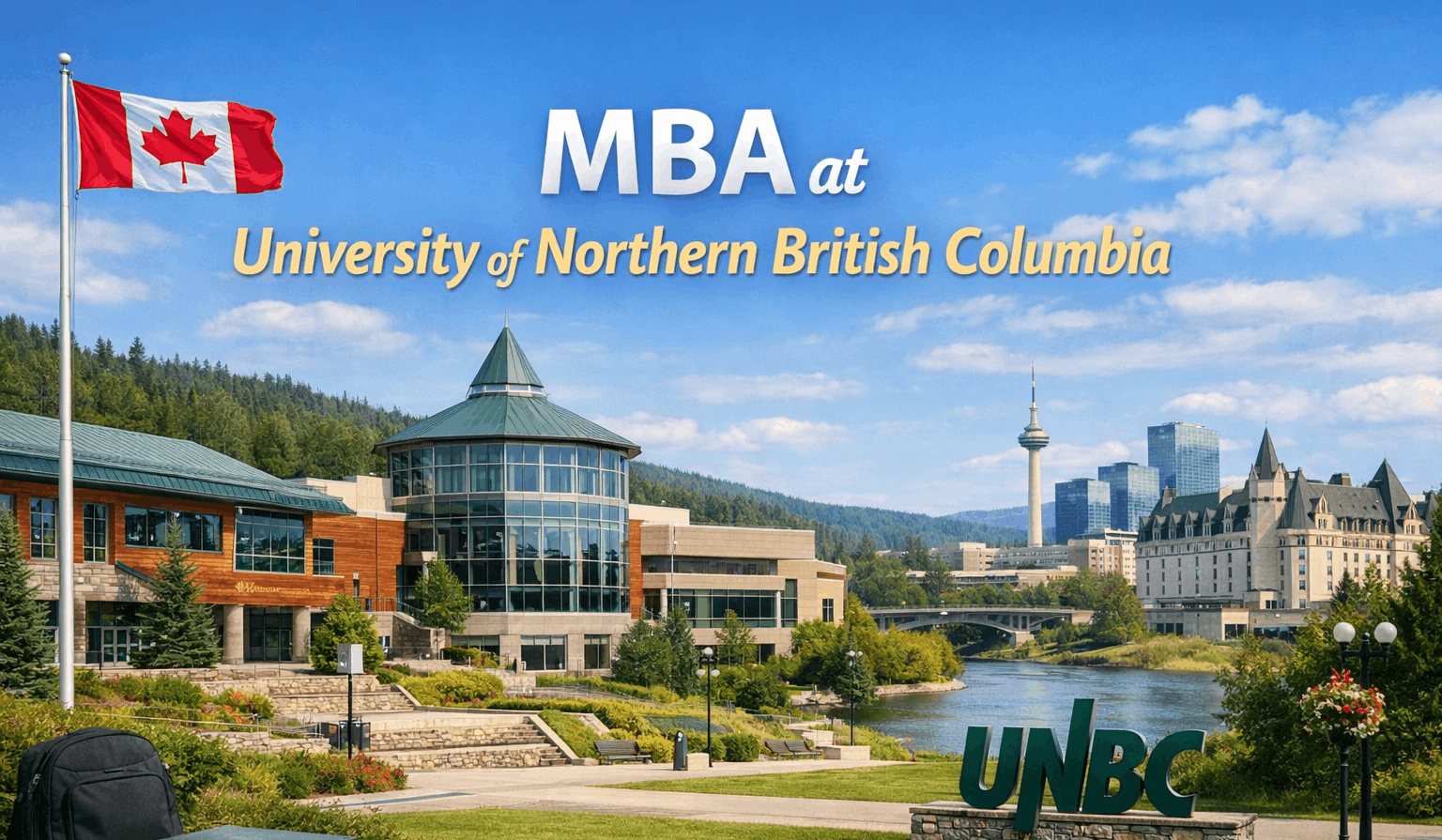
MBA at University of Northern British Columbia in 2026
Table of Contents
- Why Choose the MBA at University of Northern British Columbia?
- MBA Programme Structure at UNBC
- Eligibility and Admission Requirements for MBA at UNBC
- Tuition Fees for MBA at University of Northern British Columbia
- Cost of Living in Prince George for MBA Students
- Scholarships and Funding for MBA at UNBC
- How to Apply for MBA at University of Northern British Columbia
- Student Visa Requirements for MBA at UNBC
- Career Opportunities After MBA at University of Northern British Columbia
- Author's POV
The MBA at University of Northern British Columbia is a 21-month, course-based programme designed for professionals who want to build leadership and management skills while gaining practical business knowledge. Offered at the Prince George and Vancouver campuses, the programme combines core MBA subjects with a distinctive focus on sustainability, responsible leadership, and decision-making in diverse business environments. Students benefit from small class sizes, experienced faculty, and opportunities to collaborate with industry and community partners. The MBA at University of Northern British Columbia is well suited for those seeking career growth, leadership positions, or entrepreneurial opportunities while earning a recognised Canadian MBA with a practical and future-focused approach.
Key Highlights: MBA at University of Northern British Columbia
Key Highlights | Details |
University | University of Northern British Columbia (UNBC), Prince George, BC, Canada |
Programme Name | Master of Business Administration (MBA) |
QS World Ranking 2027 | #1201–1400 globally |
Maclean's Ranking | #11 among primarily undergraduate Canadian universities |
Official International Tuition | CAD 1,388.80 per credit hour (approx. INR 86,100) + CAD 500 MBA fee per semester (approx. INR 31,000) |
Total Credits | 54 credit hours |
Estimated Total International Programme Tuition | CAD 76,995 (approx. INR 47.8L) |
Programme Duration | 21 months full-time (while continuing to work) |
Intake | September (main); January option available |
Delivery Format | One three-day weekend per month; cohort-based |
Campuses | Prince George (main campus); Vancouver (Langara College campus) |
Minimum Work Experience | 3 years required |
Student Visa Type | Canada Student Visa (Study Permit) |
Post-Study Work | PGWP of up to 3 years |
IRCC Financial Proof | CAD 20,635 per year (approx. INR 12.8L) for living costs |
Estimated Cost of Living | Approximately CAD 3,402/month (approx. INR 2.1L/month) |
Why Choose the MBA at University of Northern British Columbia?
There are practical reasons working professionals choose the MBA at UNBC over more expensive, full-time alternatives. Here is what genuinely sets it apart for students comparing options across Canadian universities.
1. Designed for Working Professionals:
The MBA at UNBC is built so that you do not have to stop working to complete it. Classes are held on one three-day weekend per month, meaning your work schedule is disrupted for only a handful of days at a time across the 21-month programme.
2. Place-Based, Northern-Focused Curriculum:
UNBC's MBA focuses on the economic, business, and social issues in northern communities, with a place-based curriculum that enriches learning outcomes and prepares students to navigate the unique economic, political, and social challenges of doing business in the north.
3. Cohort-Based Learning With Strong Peer Connections:
The cohort-based structure means smaller class sizes that guarantee quality face-to-face interaction with professors and peers, and classes work on a cohort system which allows students to build a valuable network of colleagues.
4. Dual Campus Options Including Vancouver:
The programme is available both in Prince George and at the Langara College campus in Vancouver, giving professionals based in BC's largest city access to the same UNBC MBA without relocating to the north.
5. Pathway to Canadian PR Through PGWP:
Completing the MBA at UNBC qualifies international students for the Post-Graduation Work Permit (PGWP), providing up to three years of open work authorisation in Canada without employer sponsorship, a meaningful advantage in the Canadian immigration pathway.
Also read: Study in Canada for free in 2026 for Indian Students
MBA Programme Structure at UNBC
The MBA at UNBC runs over five semesters across 21 months and consists of 54 credit hours. The first year introduces the core disciplinary areas of business, and the second year deepens global and strategic understanding, with an option to complete a research project or additional coursework.
During the first year of the program, students are introduced to the major disciplinary areas within the field of business, including strategy, economics, accounting, finance, organizational behaviour, marketing, and operations management. During the second year, students gain a broad understanding of the global, legal and ethical environment in which organizations operate, and of the challenges facing organizations.
MBA Programme Structure:
Year / Stage | Key Focus Areas |
Year 1 (Semesters 1–3) | Strategy, economics, accounting, finance, organisational behaviour, marketing, operations management |
Year 2 (Semesters 4–5) | Global and legal environment, ethics, strategic challenges, sustainability management |
Elective / Research Option | Choose between innovative coursework or an independent research project of interest |
Delivery | One three-day weekend per month throughout both years, including summer |
What You Learn in the UNBC MBA
The UNBC MBA is a generalist programme, meaning it builds breadth across all major business functions rather than specialising in a single discipline. This suits professionals who want versatility across leadership, strategy, and management.
Core subject areas covered:
Strategy and organisational analysis
Financial management and accounting
Marketing and market intelligence
Operations management and supply chain
Organisational behaviour and human resources
Economics for business decision-making
Sustainability and community-focused business
Global business, legal, and ethical environment
Eligibility and Admission Requirements for MBA at UNBC
Admission to the MBA at University of Northern British Columbia is competitive and requires demonstrating both academic readiness and meaningful professional experience. The programme is designed for mid-career professionals, not recent graduates.
Academic and Professional Requirements
The program is open to mid-career professionals with at least three years of experience, and requires a relevant bachelor's degree in Canada. Unlike some MBA programmes, work experience is a non-negotiable requirement here rather than a preference.
Requirement | Details |
Academic Qualification | Bachelor's degree equivalent to a Canadian four-year degree; minimum GPA 3.0 (on a 4.0 scale) |
Work Experience | Minimum 3 years of professional work experience (required, not preferred) |
Career Goals Statement | Written statement describing how the UNBC MBA helps you achieve your career goals |
Contribution Statement | Written description of how your background and experience contribute to cohort learning |
References | Minimum two references required |
Financial Documents | Copy of financial statements as part of the study permit application |
English Language Requirements
International applicants whose first language is not English must provide evidence of English proficiency through an accepted test.
Test | Minimum Score |
IELTS Academic | 6.5 overall |
TOEFL iBT | 90 minimum |
PTE Academic | 65 minimum |
Duolingo English Test | 105 minimum |
Tuition Fees for MBA at University of Northern British Columbia
Tuition fees for the MBA at UNBC shifted to a per-credit-hour model effective from the 2025/26 academic year. The fees below come directly from the official UNBC calendar fees page.
International students: Tuition is $1,388.80 (approx. INR 86,100) per credit hour, plus $500.00 (approx. INR 31,000) for the MBA fee per semester. The MBA program consists of 4 semesters. For the first semester, a $2,500 (approx. INR 1.55L) deposit is due within 30 days of admission with the balance due the first day of classes. The deposit is not refundable after April 1.
Official MBA Tuition Breakdown for International Students (2026/27):
Component | Cost (CAD) | Cost (INR approx.) |
Tuition per credit hour (international) | CAD 1,388.80 | INR 862 per credit |
Total tuition (54 credits × CAD 1,388.80) | CAD 74,995 | INR 46.6L approx. |
MBA programme fee (CAD 500 × 4 semesters) | CAD 2,000 | INR 1.24L |
Pre-MBA course fee (if required, international) | CAD 886.93 | INR 55K approx. |
Initial deposit (due within 30 days of admission) | CAD 2,500 | INR 1.55L |
Estimated Total Programme Tuition | CAD 76,995 | INR 47.8L approx. |
Note: Exchange rate used: CAD 1 = INR 62.1; Verify the current rate before finalising your budget. All fees are subject to annual revision by the UNBC Board of Governors. The pre-MBA course is required for applicants who do not meet specific prerequisite course requirements.
Cost of Living in Prince George for MBA Students
Prince George is one of the most affordable cities in British Columbia, particularly when compared to Vancouver, making it a financially sensible location for an MBA in Canada. The monthly cost of living is considerably lower than any major Canadian metropolitan area.
Rent prices in Vancouver are 89.1% higher than in Prince George, while restaurant prices in Vancouver are 4.4% higher, own city comparison tool. The average total monthly cost of living in Prince George including rent is approximately CAD 3,402 (INR 2.11L).
Estimated Monthly Living Cost Breakdown in Prince George:
Expense Category | Prince George (Monthly) | Vancouver (Monthly, for comparison) |
Accommodation (1BR) | CAD 900–1,200 (INR 55.9K–74.5K) | CAD 2,300–3,200 (INR 1.43L–1.99L) |
Food and Groceries | CAD 350–500 (INR 21.7K–31.1K) | CAD 400–600 (INR 24.8K–37.3K) |
Transport | CAD 100–150 (INR 6.2K–9.3K) | CAD 120–180 (INR 7.5K–11.2K) |
Utilities | CAD 150–200 (INR 9.3K–12.4K) | CAD 200–300 (INR 12.4K–18.6K) |
Personal and Miscellaneous | CAD 200–350 (INR 12.4K–21.7K) | CAD 300–500 (INR 18.6K–31.1K) |
Source: Numbeo
Approximate Annual Living Cost in Prince George:
Estimated total: CAD 18,000–22,000 (INR 11.2L–13.7L) per year
Also read: Education Loan for Study in Canada
Scholarships and Funding for MBA at UNBC
The MBA at University of Northern British Columbia offers a range of scholarships and funding opportunities for eligible students. Awards are based on factors such as academic merit, leadership, and financial need.
Below are some of the key funding options available for MBA students at UNBC.
Scholarship / Award | Eligibility | Coverage |
UNBC Graduate Entrance Scholarships | New graduate students with strong academic performance; merit-based; reviewed at admission | Partial tuition support; amount varies |
UNBC Graduate Teaching Assistantships | Graduate students with demonstrated teaching ability; department-specific availability | Stipend + partial fee waiver |
Vanier Canada Graduate Scholarships | Canadian citizens, permanent residents, and foreign nationals studying at Canadian universities; doctoral level (note: MBA not eligible) | CAD 50,000 per year for three years (approx. INR 31.0L per year). |
Province of British Columbia International Student Scholarship | International students enrolled at a BC public post-secondary institution; merit-based | Partial tuition support |
Must check: Fully Funded Scholarships in Canada for Indian Students in 2026
How to Apply for MBA at University of Northern British Columbia
Applying to the MBA at UNBC involves submitting academic, professional, and supporting documents through the official graduate admissions process, with no centralised system like UCAS or PTCAS.
Step | Stage | What You Need to Do |
Step 1 | Research the Programme | Review the MBA curriculum, campus options, and intake dates at unbc.ca/commerce/mba |
Step 2 | Check Eligibility | Confirm your bachelor's degree, GPA, work experience (minimum 3 years), and English proficiency |
Step 3 | Prepare Documents | Gather transcripts, degree certificates, two references, career goals statement, contribution statement, CV, and financial proof |
Step 4 | Submit Application | Apply through the UNBC graduate admissions portal at unbc.ca/graduate-programs/apply |
Step 5 | Pay Deposit | Pay the CAD 2,500 deposit within 30 days of receiving your admission offer |
Step 6 | Apply for Study Permit | Submit your Canada study permit application through the IRCC portal with all required documents |
Step 7 | Arrive and Enrol | Travel to Prince George or Vancouver, complete enrolment, and begin the first semester |
Intakes and Application Timeline for MBA at UNBC
UNBC's MBA primarily follows a September start, with the cohort structure meaning intake dates are strictly scheduled and rolling admissions are limited.
MBA at UNBC Intakes:
Intake | Programme Start | Application Notes |
September (Main) | September | Primary intake; applications typically open several months prior |
January (Secondary) | January | Available per UNBC's academic schedule; confirm directly with MBA office |
Key Points:
The cohort-based nature of the programme means places are strictly limited. Applying early is strongly advisable to avoid missing the cohort.
The CAD 2,500 deposit is due within 30 days of admission and is non-refundable after April 1 for September intake.
International students should factor in study permit processing time, which can range from four to twelve weeks depending on the country of application.
Student Visa Requirements for MBA at UNBC
International students enrolling in the MBA at University of Northern British Columbia need a Canada Study Permit, issued by Immigration, Refugees and Citizenship Canada (IRCC). This is the standard permit for all full-time international students at Canadian designated learning institutions (DLIs).
How the Study Permit Process Works:
A study permit application is submitted online through the IRCC portal, or in some cases through a Canadian visa application centre in the student's home country. UNBC is a designated learning institution (DLI number O19268734862), which is a requirement for international students to be eligible for a study permit.
Eligibility Criteria:
Accepted admission offer from UNBC with a valid letter of acceptance
Proof of sufficient financial resources to cover tuition and living costs
Valid passport with sufficient validity for the programme duration
No criminal record (a police clearance certificate may be required)
Medical examination may be required depending on country of origin
Financial Requirements:
IRCC updated the minimum financial proof requirement. International students must now demonstrate CAD 20,635 (INR 12.8L) per year for living costs, in addition to first-year tuition fees and travel costs.
Documents Required for Canada Study Permit:
Valid passport
Acceptance letter from UNBC confirming DLI status
Proof of financial resources (bank statements, education loan letter, scholarship letter)
Completed online study permit application (IMM 1294)
Digital photo meeting IRCC specifications
Biometrics (required for most nationalities; fee CAD 85 per person)
Statement of purpose/letter of explanation (recommended)
Police clearance certificate (if required by country)
Medical examination results (if required by country)
Post-Study Work: Post-Graduation Work Permit (PGWP):
Completing the MBA at UNBC qualifies international graduates for the Post-Graduation Work Permit (PGWP), one of Canada's most valuable immigration pathways for international students. The PGWP allows graduates to work in Canada for any employer, in any occupation, without employer sponsorship. Programmes of 21 months or more qualify for a PGWP up to three years in duration.
Career Opportunities After MBA at University of Northern British Columbia
The UNBC MBA is built for career progression rather than immediate job placement after graduation, and the programme's value compounds for professionals who are already working in their field and seeking to move into senior leadership roles.
Top Job Roles and Approximate Salaries After MBA in Canada (Glassdoor, 2026):
Job Role | Approximate Annual Salary (British Columbia) |
Business Analyst | CAD 65,000–95,000 (INR 40.4L–59L) |
Management Consultant | CAD 75,000–110,000 (INR 46.6L–68.3L) |
Operations Manager | CAD 70,000–100,000 (INR 43.5L–62.1L) |
Finance Manager | CAD 80,000–120,000 (INR 49.7L–74.5L) |
General Manager | CAD 85,000–130,000 (INR 52.8L–80.7L) |
Project Manager | CAD 75,000–110,000 (INR 46.6L–68.3L) |
HR Manager | CAD 65,000–95,000 (INR 40.4L–59L) |
Source: Glassdoor
Must check: Average Salary in Canada for Indian Students in 2026
Author's POV
The MBA at University of Northern British Columbia is a good fit for professionals who value practical learning over global rankings. While UNBC isn't as well-known as Canada's largest business schools, it offers smaller class sizes, closer interaction with faculty, and a curriculum designed around real business challenges. The tuition is also more affordable than many MBA programmes in major Canadian cities, making it a sensible option for students looking to control costs.
Another advantage is British Columbia's growing economy, which creates opportunities in sectors such as natural resources, healthcare, logistics, technology, and public services. The MBA is best suited for students who want to strengthen their leadership skills, gain Canadian work experience, and advance into management roles. For those focused on long-term career growth rather than university prestige alone, the MBA at University of Northern British Columbia delivers strong value for the investment.
Connect with our experts for a free 1:1 counseling session to explore course options, career pathways, and more.