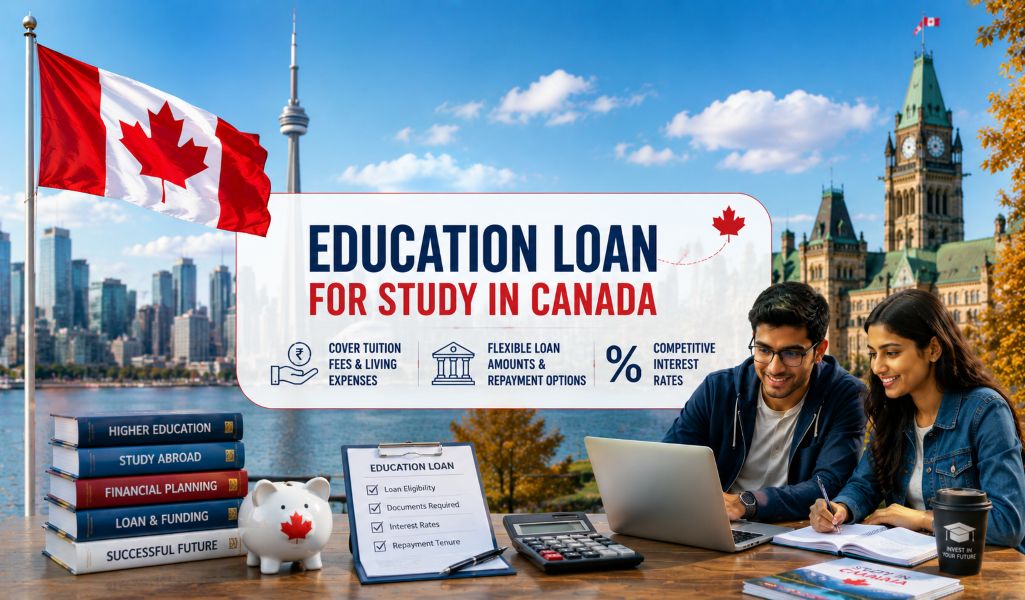
Education Loan for Study in Canada
Table of Contents
- Types of Education Loans Available for Canada
- Best Banks & Education Loan Providers for Canada
- Education Loan Amount for Different Study Levels
- What Does an Education Loan Cover?
- Education Loan Interest Rates
- Eligibility Requirements
- Documents Required for Education Loan for Canada
- Education Loan With Collateral vs Without Collateral
- Education Loan Without Collateral for Canada
- GIC Requirement and Education Loan
- How to Apply for an Education Loan for Study in Canada
- Education Loan Sanction Timeline
- Education Loan Repayment Process
- Scholarships vs Education Loan
- Common Reasons for Education Loan Rejection
- Author’s Final Thought
Studying in Canada is a significant financial investment, although education loan for study in Canada can help Indian students cover tuition fees, living expenses, books, travel, and other academic costs without delaying their higher education plans. Students can choose from Indian public and private banks, NBFCs, as well as international lenders that offer customised education loans with flexible repayment options. Depending on the lender, loan amounts can go up to ₹3 crore, while interest rates generally range between 8.40% and 13.25%, with repayment usually beginning after a moratorium period once the course is completed.
To qualify for an education loan for study in Canada, students need an admission offer from a recognised Designated Learning Institution (DLI), academic documents, English language test scores, and financial documents from a co-applicant when required. Traditional banks often require collateral or a financially stable co-applicant for higher loan amounts, whereas international lenders like MPOWER Financing and Prodigy Finance offer collateral-free loans for eligible universities. Processing timelines generally vary between 7 and 25 days, making it important to begin planning your finances well before your Canadian study permit application.
Key Highlights
Particular | Details | Approximate Value |
Maximum Loan Amount | Up to ₹3 Crore | Depends on lender |
Interest Rate | 9%–14% p.a. | Varies by lender |
Repayment Period | Up to 15 Years | Lender-specific |
Moratorium Period | Course Duration + 6–12 Months | Varies |
Collateral-Free Loan | Available | Selected lenders |
GIC Funding | Covered by many lenders | CAD 22,895 (Approx. ₹14 lakh) |
Eligible Courses | UG, PG, MBA, Diploma, PhD | Recognised Canadian DLIs |
Types of Education Loans Available for Canada
Students can Study in Canada and choose from different loan categories depending on their financial profile, collateral availability, and preferred lender.
Loan Type | Best For | Collateral Requirement |
Secured Education Loan | Large loan amounts | Yes |
Unsecured Education Loan | High academic profiles | No |
International Student Loan | Selected universities | Usually No |
Secured loans provide lower interest rates and higher borrowing limits, whereas unsecured loans offer quicker approvals but may require a financially strong co-applicant.
Tip: Apply for loan immediately after receiving admission confirmation.
Best Banks & Education Loan Providers for Canada
Indian students have access to several government banks, private lenders, NBFCs, and international financing organisations.
The following highlights the Interest rate for Education Loan for Study in Canada:
Lender | Maximum Loan | Interest Rate* |
State Bank of India (SBI) | Up to ₹3 Crore | From ~9% |
Bank of Baroda | Up to ₹1.5 Crore | Competitive |
Punjab National Bank | Up to ₹2 Crore | Competitive |
Axis Bank | Up to ₹1.5 Crore | 10%–13% |
HDFC Credila | Up to 100% Funding | Varies |
Avanse Financial Services | Up to ₹75 Lakh+ | Varies |
InCred Education Loans | Up to ₹1 Crore | Varies |
Prodigy Finance | Program-dependent | No Collateral |
MPOWER Financing | Eligible Universities | No Collateral |
*Interest rates are subject to change
Tip: Compare multiple lenders before finalising a loan.
Public Sector Banks
Government banks like SBI, Bank of Baroda, and Punjab National Bank remain popular because they offer competitive interest rates, longer repayment tenures, and substantial loan amounts for recognised Canadian universities.
Private Banks & NBFCs
Private lenders generally offer quicker approvals, higher funding percentages, and simplified documentation. Although their interest rates may be slightly higher, they are often preferred by students requiring faster loan disbursement.
International Education Loan Providers
Institutions such as Prodigy Finance and MPOWER Financing evaluate applicants based on university rankings and future earning potential rather than family income, making them suitable for students seeking collateral-free funding.
Education Loan Amount for Different Study Levels
The amount students can borrow depends on the course level, university, and estimated total cost of education.
Study Level | Typical Loan Amount | Covers |
Bachelor's Degree | ₹20–60 Lakh | Tuition + Living Expenses |
Master's Degree | ₹25 Lakh–₹1 Crore | Complete Education Cost |
MBA Programs | ₹40 Lakh–₹1.5 Crore | Tuition + Living + Travel |
PhD Programs | ₹20–75 Lakh | Research & Living Expenses |
Students attending premium universities may qualify for significantly higher loan amounts depending on the lender's policies.
What Does an Education Loan Cover?
Education loans for Canada generally extend beyond tuition fees and finance most major educational expenses.
Expense | Remarks |
Tuition Fees | Complete or Partial |
Accommodation | University or Private Housing |
Living Expenses | Daily Expenses |
Books & Study Material | Academic Costs |
Laptop & Equipment | Program Dependent |
Health Insurance | Mandatory Expense |
Airfare | One-time Travel |
Visa Charges | Application Costs |
GIC Deposit | Subject to Lender |
Education Loan Interest Rates
Interest rates differ across lenders depending on collateral, university ranking, applicant profile, and course. Applicants with strong academic records, reputed universities and collateral generally receive lower interest rates.
Lender Category | Typical Interest Rate | Processing Speed |
Public Banks | 9%–11% | Moderate |
Private Banks | 10%–13% | Fast |
NBFCs | 11%–14% | Very Fast |
International Lenders | Program-specific | Fast |
Eligibility Requirements
Lenders also evaluate repayment capacity, university ranking, employability of the chosen program, and the applicant's academic consistency. Meeting the lender's eligibility is important improves the chances of loan approval.
Requirement | Secured Loan | Unsecured Loan |
Admission to Canadian DLI | Mandatory | Mandatory |
Academic Performance | Required | Strong Profile Preferred |
Co-applicant | Required | Mandatory |
Stable Family Income | Preferred | Essential |
Collateral | Required | Not Required |
Tip: Choose recognised Canadian DLIs with good employability outcomes.
Documents Required for Education Loan for Canada
Preparing the correct documents before applying can significantly improve approval chances and reduce processing delays. Some lenders may also request employment documents of the co-applicant, income tax returns, salary slips, and net-worth statements.
Document | Purpose | Required |
Admission Letter from Canadian DLI | Proof of Admission | Yes |
Academic Transcripts | Academic Evaluation | Yes |
Passport | Identity Verification | Yes |
Cost of Attendance Estimate | Loan Assessment | Yes |
Co-applicant Income Proof | Repayment Capacity | Yes |
Bank Statements | Financial Assessment | Yes |
Property Documents | Secured Loan Cases | If Applicable |
GIC Requirement Details | Visa Funding Assessment | Often Required |
Education Loan With Collateral vs Without Collateral
One of the biggest decisions students face is whether to apply for a secured or unsecured education loan.
Particular | With Collateral | Without Collateral |
Loan Amount | Higher | Moderate |
Interest Rate | Lower | Higher |
Approval Criteria | Asset-based | Profile-based |
Secured loans are generally preferred for expensive MBA and master's programs as they offer larger funding amounts and lower interest rates. Unsecured loans are suitable for students admitted to highly ranked universities with strong academic profiles.
Education Loan Without Collateral for Canada
Many students seek collateral-free education loans, especially when they do not have property or other assets to pledge.
Several banks, NBFCs, and international lenders offer unsecured loans for eligible students.
Lender | Loan Type | Maximum Funding |
HDFC Credila | Unsecured | Program-dependent |
Axis Bank | Unsecured | Up to ₹75 Lakh+ |
Avanse | Unsecured | Profile-based |
InCred | Unsecured | Up to ₹1 Crore |
Prodigy Finance | No Collateral | University-based |
MPOWER Financing | No Collateral | University-based |
For unsecured loans, lenders place greater emphasis on:
University ranking
Future employability
Academic performance
Co-applicant income
Course selection
Students admitted to top Canadian universities generally have stronger approval prospects.
GIC Requirement and Education Loan
Canada requires international students to demonstrate proof of living expenses when applying for a study permit. One of the most important components is the Guaranteed Investment Certificate (GIC).
The table below highlights the current requirement.
Particular | Amount | Approximate INR |
GIC Requirement | CAD 22,895 | Approx. ₹14 lakh |
Purpose | Living Expense Proof | Mandatory |
Refund Mechanism | Monthly Release | During Study Period |
Education loan providers allow students to use sanctioned loan amounts to fund the GIC requirement before departure. This is useful because students often need to arrange GIC funds before Canada Study Visa approval.
How to Apply for an Education Loan for Study in Canada
Applying systematically improves approval chances and ensures students receive funds on time.
Step | Action | Typical Timeline |
1 | Secure Admission Offer | Varies |
2 | Compare Lenders | 1–2 Weeks |
3 | Submit Loan Application | 1–3 Days |
4 | Document Verification | 1–2 Weeks |
5 | Credit & Profile Assessment | 3–10 Days |
6 | Loan Sanction | 1–3 Weeks |
7 | Disbursement | As Required |
Students should ideally begin the loan process immediately after receiving their admission offer.
Education Loan Sanction Timeline
Loan approval timelines vary depending on the lender and whether collateral is involved.
Loan Type | Average Processing Time | Remarks |
Public Bank | 2–6 Weeks | Detailed Verification |
Private Bank | 1–3 Weeks | Faster Processing |
NBFC | 3–10 Days | Quick Approval |
International Lender | 1–2 Weeks | University-Based Evaluation |
Students applying during peak admission seasons should allow additional processing time.
Education Loan Repayment Process
Most education loans come with flexible repayment structures designed to reduce financial pressure during studies.
Feature | Details | Benefit |
Moratorium Period | Course Duration + 6–12 Months | No Immediate EMI Burden |
Repayment Tenure | Up to 15 Years | Lower Monthly Payments |
Partial Interest Payment | Optional During Study | Reduces Overall Cost |
Graduates can usually begin EMI repayment after completing their studies and securing employment.
Tax Benefits on Education Loans
Education loans also provide tax advantages under Indian income tax regulations.
Benefit | Applicable Section | Advantage |
Interest Deduction | Section 80E | Reduces Taxable Income |
Maximum Limit | No Fixed Upper Limit | Full Interest Deduction |
Deduction Period | Up to 8 Years | Long-term Benefit |
Only the interest component qualifies for deduction, not the principal amount.
Scholarships vs Education Loan
Students often combine scholarships with education loans to reduce overall borrowing requirements.
Funding Source | Repayment Required | Coverage |
Scholarship | No | Partial or Full |
Education Loan | Yes | Comprehensive |
Assistantships | No | Partial Expenses |
Even students receiving scholarships may still require loans to cover living expenses, GIC requirements, or accommodation costs.
Common Reasons for Education Loan Rejection
Understanding rejection factors for Education Loan for Study in Canada helps applicants strengthen their profiles before applying.
Reason | Impact | Solution |
Weak Academic Record | Reduced Approval Chances | Improve Overall Profile |
Low Co-applicant Income | Repayment Concern | Additional Financial Proof |
Unrecognised Institution | Loan Rejection | Choose Approved DLI |
Poor Documentation | Processing Delays | Complete Documentation |
Low Credit Profile | Risk Assessment Issue | Strengthen Financial Records |
Tip: Ensure your co-applicant has a stable income source
Author’s Final Thought
Education loan for study in Canada provide the financial support needed to pursue undergraduate, master's, MBA, diploma or doctoral programs without placing immediate pressure on family finances. From public sector banks offering competitive interest rates to NBFCs and international lenders providing collateral-free options, students today have access to a wide range of funding solutions.
Need help selecting the right education loan provider for your Canadian university? Connect on free 1:1 conselling session with our study abroad experts to help you compare loan options, understand GIC requirements, and identify the most suitable funding solution for your academic goals.